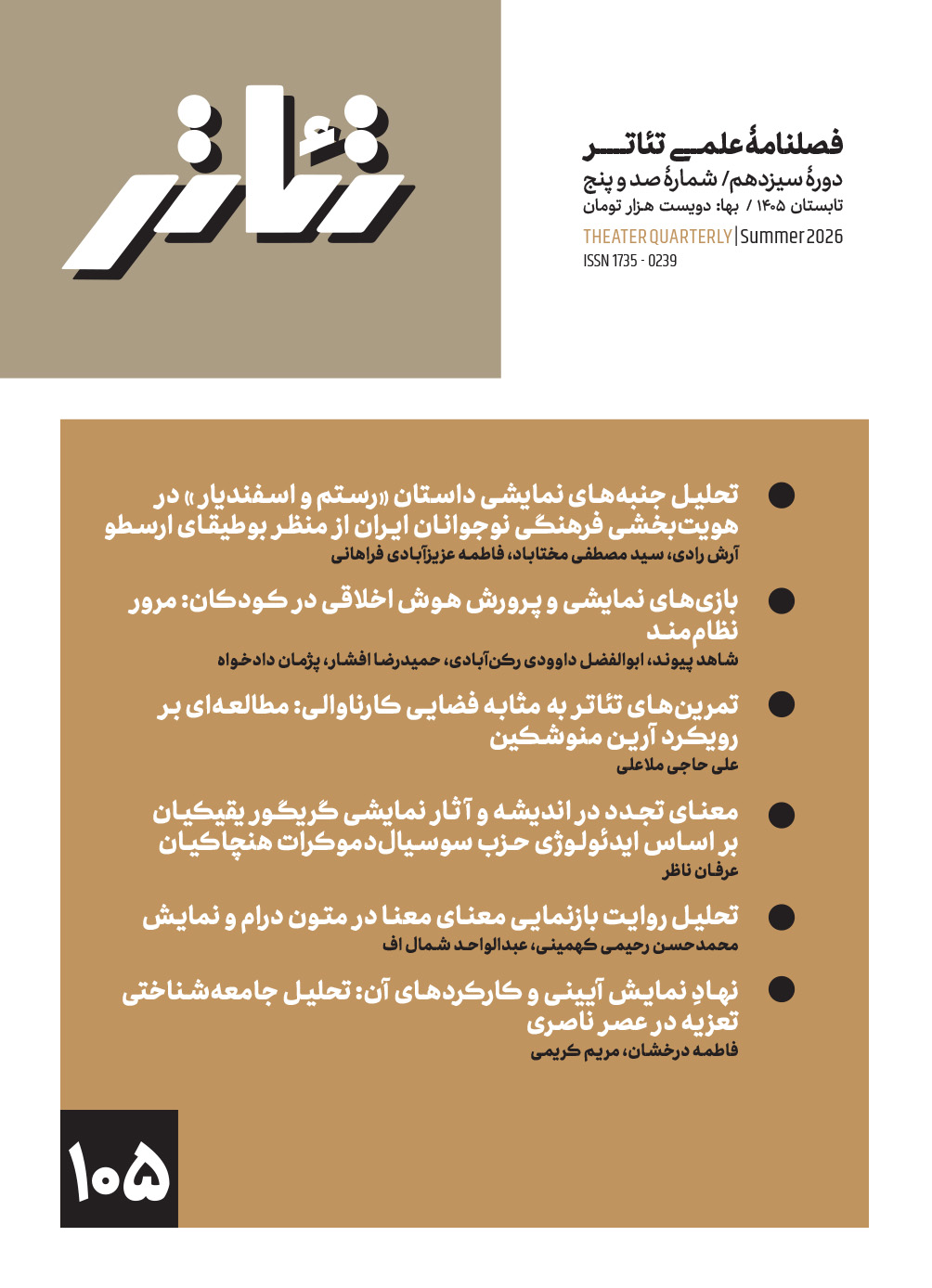
نوع مقاله : مقاله پژوهشی
عنوان مقاله English
نویسنده English
Theatre rehearsal has long occupied a paradoxical position within theatre scholarship. Although it is the primary site where theatrical ideas are generated, negotiated, embodied, and transformed, academic attention has largely remained focused on the finished performance rather than on the creative processes that make performance possible. Rehearsal is commonly regarded as a transitional stage whose principal function is to prepare actors for public presentation. Such a product-oriented perspective obscures the rehearsal room as an autonomous space of artistic production where theatrical language, bodily expression, interpersonal relationships, and aesthetic conventions are continuously questioned and reinvented. This article challenges that assumption by proposing that rehearsal should be understood not merely as preparation for performance but as an independent creative event characterized by experimentation, collective invention, and continual transformation. Drawing upon Mikhail Bakhtin’s theory of carnival, the article develops a conceptual framework through which theatrical rehearsal may be interpreted as a carnivalesque space. While Bakhtin formulated his theory to explain medieval and Renaissance popular culture, many of its central concepts—including the suspension of hierarchy, inversion of established order, the grotesque body, collective participation, dialogism, heteroglossia, play, laughter, and becoming—provide a productive vocabulary for analyzing the dynamics of rehearsal. Rather than functioning as a fixed methodological model, carnival is understood here as a temporary condition in which institutional structures are suspended, official authority is destabilized, and alternative forms of creativity become possible. From this perspective, rehearsal constitutes a liminal environment where theatrical conventions are deliberately unsettled before new artistic structures emerge. The study investigates this proposition through the rehearsal methodology and performance practice of Ariane Mnouchkine and the Théâtre du Soleil, one of the most influential examples of collaborative theatre in contemporary performance. Since its establishment in 1964, Théâtre du Soleil has consistently rejected conventional divisions between playwright, director, actor, designer, and technician in favor of collective creation. Mnouchkine’s productions emerge through lengthy rehearsal periods based on improvisation, physical exploration, intercultural exchange, and collaborative authorship. Instead of imposing predetermined interpretations upon performers, rehearsal becomes the principal mechanism through which theatrical meaning is discovered. This collaborative philosophy provides an ideal context for examining rehearsal through Bakhtin’s carnivalesque perspective. The central question guiding this research therefore asks how theatrical rehearsal can be conceptualized not simply as a preparatory phase but as a carnivalesque environment that enables artistic creation through the temporary suspension of theatrical norms and hierarchical structures. The article adopts a qualitative descriptive-analytical approach and employs multiple case studies drawn from Mnouchkine’s productions, including “Ça Passe,” “L’Âge d’Or (The Golden Age),” “1789,” “Les Atrides,” and “Richard II.” Rather than analyzing these productions solely as finished performances, the research focuses on the rehearsal principles and creative processes through which they were generated. The first case study, “Ça Passe”, demonstrates how rehearsal can function as a space of perpetual transition. Developed through extensive collective improvisation rather than the realization of a predetermined script, the production foregrounded process over product and privileged discovery over execution. The mobile stage, which travelled between two groups of spectators, dissolved the conventional spatial hierarchy separating performers and audiences and transformed theatrical space into a fluid environment of continual movement. Such instability reflects Bakhtin’s understanding of carnival as a world in constant becoming, where fixed meanings are replaced by temporary configurations and theatrical reality remains deliberately unfinished. The rehearsal process itself embodied these qualities by encouraging actors to respond spontaneously to emerging situations instead of reproducing predetermined dramatic actions. A similar logic informs “1789,” although here carnival acquires an explicitly political dimension. Rather than reconstructing the French Revolution through historical realism, Mnouchkine transformed revolutionary history into a popular theatrical celebration inspired by fairs, processions, circus traditions, and street performance. During rehearsals, actors collectively developed scenes that combined satire, parody, music, physical comedy, and improvisation, producing a theatrical language rooted in popular performance rather than official historical representation. In this production, not only theatrical conventions but also social and political hierarchies are temporarily suspended. Kings, aristocrats, revolutionaries, and ordinary citizens occupy the same performative space, where authority is desacralized through collective laughter and parody. As in Bakhtin’s carnival, inversion is not simply a reversal of power but a revelation that existing structures are historically contingent rather than permanent. The rehearsal process itself reflects this principle by replacing authoritarian direction with collective experimentation, allowing performers to participate actively in constructing the political imagination of the production. The intercultural dimension of carnival becomes particularly significant in “Les Atrides” (1990–1992). During both rehearsals and performance, Mnouchkine combined performative vocabularies derived from Indian Kathakali, Japanese Noh, and Western classical theatre to create a theatrical language that transcended conventional cultural boundaries. Rather than appropriating these traditions as fixed aesthetic models, rehearsal became a dialogic encounter in which different theatrical systems interacted, challenged one another, and generated new expressive possibilities. This article describes such a process as transcultural carnival. Cultural identities remain recognizable but temporarily lose their hierarchical separation, entering a shared creative field in which difference becomes the source of theatrical innovation. This intercultural philosophy reaches another stage of development in “Richard II”. In reimagining Shakespeare’s history play, Mnouchkine integrated Japanese Noh and Kabuki, Indian Kathakali, and Balinese theatrical traditions to create a performance situated between theatre, ritual, and mythology. Rather than seeking cultural authenticity or historical reconstruction, rehearsal explored the performative principles shared by these traditions, enabling actors to develop bodies that simultaneously embodied kings, deities, ritual figures, and ordinary human beings. Sacred and profane, tragedy and comedy, history and myth coexist within a single theatrical universe. Such hybridity exemplifies Bakhtin’s carnivalesque imagination, where incompatible worlds intersect without dissolving into uniformity. The rehearsal room provided the essential conditions for these encounters because it temporarily suspended aesthetic certainty and encouraged performers to negotiate unfamiliar corporeal and cultural vocabularies through sustained collective experimentation. Taken together, these productions demonstrate that the originality of Théâtre du Soleil lies less in any particular visual style than in a consistent philosophy of rehearsal. Across widely different historical subjects and theatrical traditions, Mnouchkine repeatedly treats rehearsal as an open-ended process in which artistic meaning emerges through collaboration rather than prescription. Improvisation, physical investigation, intercultural dialogue, and collective authorship are not supplementary techniques but the very principles through which performance is generated. The rehearsal room therefore functions as creative commons in which authority is redistributed, aesthetic conventions are questioned, and theatrical language remains permanently open to transformation. The findings of this study suggest that theatrical rehearsal should be understood as an autonomous field of cultural production rather than merely as preparation for performance. When viewed through Bakhtin’s theory of carnival, rehearsal appears as a temporary suspension of institutional order that enables experimentation, risk-taking, and collective creativity. Within this carnivalesque environment, hierarchical distinctions between director and actor become less rigid, the disciplined body gives way to the grotesque body, and established theatrical conventions are replaced by dialogic processes of negotiation and invention. Creativity arises precisely because rehearsal remains unfinished, unstable, and receptive to change. The principal contribution of this research is the conceptualization of the carnivalesque rehearsal as a theoretical model within rehearsal studies. While previous scholarship has examined rehearsal primarily from pedagogical, psychological, or production-oriented perspectives, this study demonstrates that Bakhtin’s theory offers a productive framework for understanding rehearsal as a distinct aesthetic and cultural practice. By establishing a dialogue between Bakhtinian philosophy and the rehearsal methodology of Ariane Mnouchkine, the article extends the application of carnival theory from literary and cultural studies to the practical domain of theatrical creation. More broadly, it contributes to contemporary debates on collaborative theatre, devised performance, intercultural practice, and performance research by repositioning rehearsal as the primary site where theatrical knowledge is produced. Ultimately, rehearsal as carnival is not proposed as a specific directing technique or rehearsal method but as a philosophy of artistic creation. It is a mode of practice founded upon collective participation, the temporary dissolution of fixed structures, embodied experimentation, and the continual emergence of new theatrical possibilities. In a theatrical culture where aesthetic conventions quickly become institutionalized and repetitive, the carnivalesque rehearsal offers a critical alternative that restores uncertainty, dialogue, play, and transformation to the center of the creative process. It is within this liminal and carnivalesque space that theatre continuously reinvents not only its performances but also its bodies, languages, relationships, and ways of imagining the world.
کلیدواژهها English