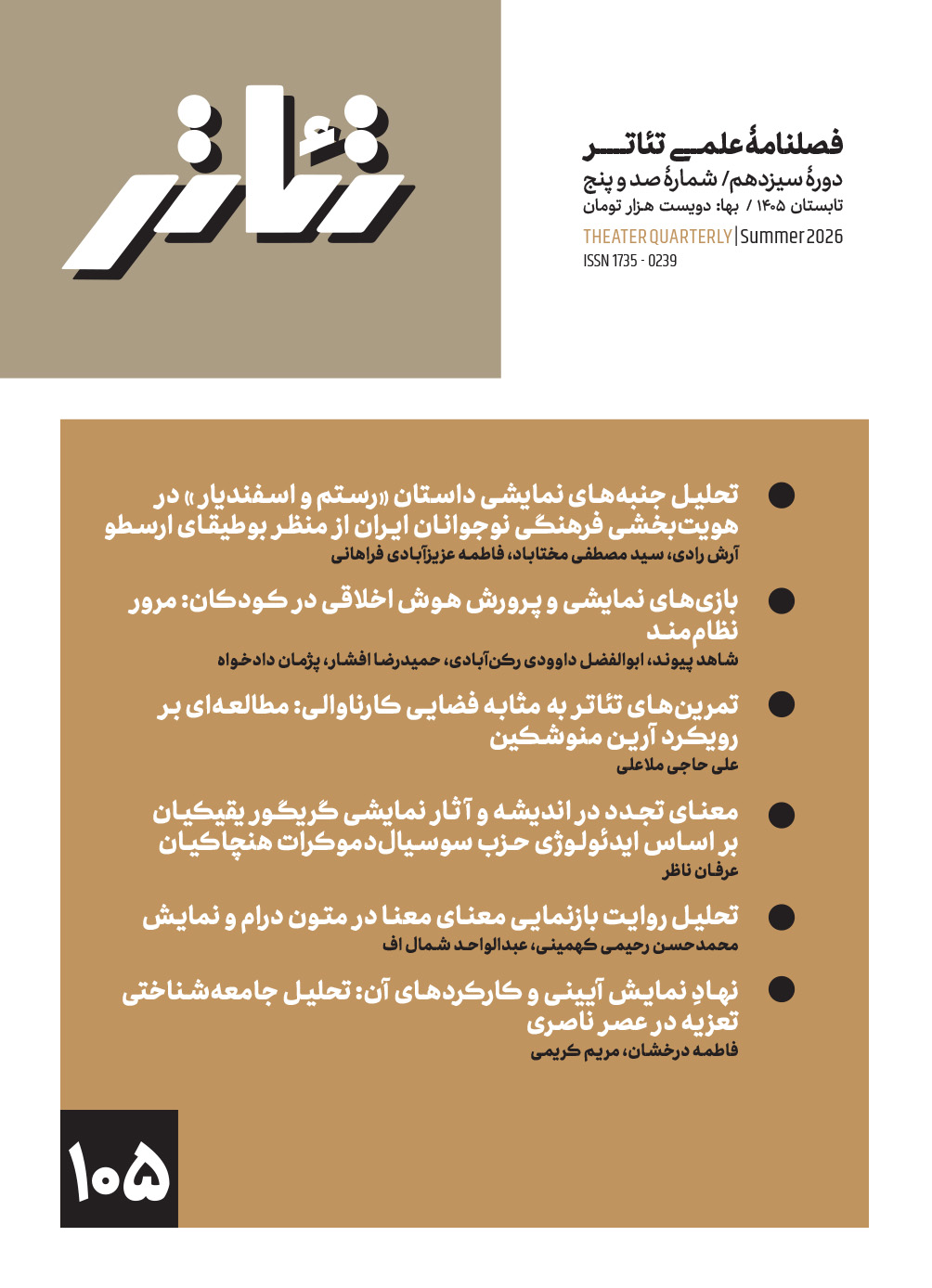
نوع مقاله : مقاله پژوهشی
عنوان مقاله English
نویسندگان English
In the realm of modern thought and art, contemporary humanity is increasingly confronted with existential and ontological challenges that have given rise to a profound crisis of meaning. Characterized by doubt, anxiety, meaninglessness, distrust, and a pervasive sense of emptiness, this crisis permeates both individual and collective life. As a result, re-examining the concept of meaning and the ways in which it is formed and represented in cultural and artistic works has become increasingly important, particularly in dramatic and theatrical texts. Against this backdrop, the present study investigates the representation of the meaning of meaning in dramatic and theatrical texts. From this perspective, the central research question does not concern the what of meaning but the how of its construction within the framework of narrative mechanisms. Ultimately, the overarching objective of this study is to transcend purely theme-based readings and to achieve a structural understanding of the phenomenon of meaning in modern texts. The research methodology is grounded in narratological analysis, drawing upon the theoretical model of Gérard Genette, the prominent French structuralist narratologist. This study is descriptive-analytical in nature and qualitative in strategic approach. Utilizing Genette’s analytical framework—which rests upon three fundamental axes, namely time, mood (focalization), and voice—the data are examined through four distinct stages. In the first stage, the three narrative levels—story (events as plot content), narrative (mode of representation), and narrating (the act of telling and the narrator’s position)—are differentiated, as Genette emphasizes that narrative analysis is only possible when these three levels are distinguished from one another. In the second stage, the temporal axis is analyzed through three subcomponents: order (temporal displacements such as analepsis and prolepsis), duration (the ratio between story time and narrative time, realized through scene, pause, summary, and ellipsis), and frequency (repetition and narrative returns). The third stage addresses focalization or mood, examining the transmission of information, point of view, and the degree of the audience’s access to characters’ consciousness. In this stage, three types of focalization are distinguished: internal focalization (access to the character’s mind), external focalization (restriction to external behavior), and zero focalization or omniscient (unlimited access). Finally, the fourth stage analyzes voice and narrative levels, including narrator type (homodiegetic, autodiegetic, or heterodiegetic), narrative time (subsequent, simultaneous, or interpolated), and the various strata of narration (meta-narrative, intra-diegetic, and extra-diegetic). The corpus of this study consists of six seminal and influential works from modern literature, philosophy, and drama, selected purposefully. Furthermore, to mitigate interpretive bias, expert auditing was employed, and all analytical steps were methodically documented to ensure traceability, reviewability, and replicability for other researchers. In addition, the use of direct textual citations and the alignment of results with authoritative theoretical sources increased the dependability of the findings, while precise description of analytical stages guaranteed methodological transparency. The findings clearly indicate that temporal components, focalization, and voice within Genette’s model play a foundational and determining role in shaping, suspending, transforming, or dismantling meaning in modern texts. The crisis of meaning in these works is not merely manifested in theme or explicit content but is represented in the very guise, form, and structure of narrative. In other words, the meaning of meaning in these texts emerges from a dialectical and complex relationship between form and existential experience, such that concepts such as waiting, guilt, alienation, faith, death, and the loss of certainty are not treated as independent subjects but are internalized within the mode of narration, with narrative form itself becoming the embodiment of thought and experience. In the detailed analysis of individual works, first, Waiting for Godot is a play in which the narrative structure is predicated upon the absence of linear progression and the predominance of repetition. From Genette’s temporal perspective, the collapse of linear order and movement within a closed cycle of linguistic and situational repetitions objectifies the timelessness of absurdity. Phrases such as “Nothing to be done” and the motif “Nobody comes, nothing happens” demonstrate that repetition in this work is not merely a linguistic device but the fundamental structure of the characters’ lived experience. Moreover, external focalization, which restricts access to the characters’ interiority, creates a meaningful distance between the audience and the characters, conveying the crisis of meaning through the observation of repetitive and futile situations. The simultaneous voice further intensifies the state of suspension and timelessness. In Crime and Punishment, internal focalization and the narrator’s alignment with Raskolnikov’s turbulent and tormented mind transform guilt and punishment into a psycho-ethical and existential experience. The deceleration of narrative time during critical moments—such as the murder scene and subsequent anxiety—turns the moment of crime from an external event into an extended, compressed, and psychological experience. In contrast, longer temporal periods are narrated through summary, indicating that the significance of time in the novel is subordinate to the psychological and moral weight of events rather than their actual duration. Punishment begins within the narrative and the character’s consciousness long before any juridical verdict is pronounced, and the third-person narrator, by reducing distance from the character’s consciousness, immerses the reader in his psychological space. In The Metamorphosis, the opening sentence, with its neutral and reportorial tone, presents the extraordinary and the uncanny as utterly ordinary, thereby generating semantic suspension and alienation at the formal level of narration. The absolute internal focalization, which imprisons the reader within Gregor’s mind and denies access to other characters’ thoughts, reproduces alienation not only at the thematic level but also at the formal level of narrative. Descriptive pauses and extended scenes in narrative time intensify the entrapment and isolation of the character, transforming the breakdown of human communication into the very structure of narrative experience. The repetition of Gregor’s failed attempts to communicate with his family demonstrates that the central crisis of the work is the collapse of the possibility of human communication through language. In Thus Spoke Zarathustra, the work progresses with an oratorical, allegorical, and poetic structure, distancing itself from linear time and approaching mythical and cyclical time. The idea of “eternal recurrence” imposes a logic of repetition upon the text, producing meaning not through linear reasoning but through allegorical repetition and continuous rearrangement. In the axis of voice, the text oscillates between Zarathustra’s voice and a third-person narrator, causing the text to move between narrative, oratory, and philosophical revelation. This voice does not carry absolute authority but is a mobile, metaphorical, and multi-layered voice that produces meaning in the process of telling and retelling. In Fear and Trembling, Kierkegaard, under a pseudonym, repeatedly retells the narrative of Abraham’s sacrifice of his son from various angles. Repetition here is not simple retelling but a method for exploring different possibilities of meaning. From Genette’s temporal perspective, the text, through repeated returns to a sacred narrative, converts historical time into reflective time, transforming a past event into a present and existential problem. In the axis of mood, focalization is shaped through the consciousness of the narrator-thinker, and the reader encounters an Abraham filtered through anxiety, bewilderment, and reason’s inability to comprehend faith. The meaning of faith does not appear in propositional certainty but is formed in the interval between ethical understanding and the leap of faith. Finally, in The Tragic Sense of Life, Unamuno identifies the fundamental human problem as the conflict between the desire for immortality and the awareness of death. The narrative structure is a mixture of philosophical reflection, direct address, memory, anecdote, and internal debate, with the author, narrator, thinking character, and interpreter largely coinciding. Narrative time is non-linear and associative, moving from memory to argument, from argument to existential questioning, and from questioning to direct address. Internal focalization and self-reflection dominate the text, and the autodiegetic philosophical voice portrays the tragedy of human consciousness as an internal, unfinished, and dynamic process. The final conclusions of the research emphasize that, according to Genette’s theory, narrative is constituted by the three fundamental axes of time, mood, and voice, each of which determines the audience’s apprehension of the textual world and the perception of meaning. The systematic analysis of the selected texts demonstrates that modern authors and playwrights, through conscious and purposeful manipulation of these three components, elevate meaning from the level of explicit message and overt content to that of existential experience and narrative perception. In other words, narrative form is not a neutral and passive container for content but an ontological bearer of meaning itself, and the fundamental crises of modern humanity are manifested in the very manner of their narration. A comparative examination of the works reveals that each text foregrounds one of the fundamental potentials of modern narrative in the production of meaning: Beckett employs repetitive time and external focalization to objectify absurdity.
کلیدواژهها English